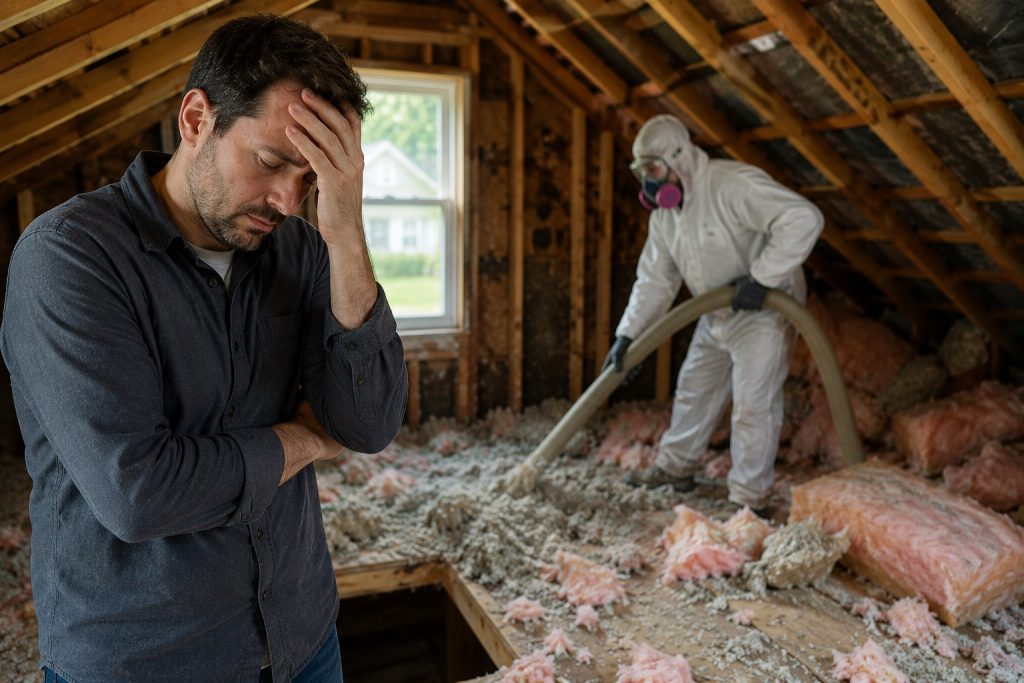

Selecting insulation removal companies without rigorous vetting consistently leads to safety failures, missed rebates, and energy performance that falls short of expectations. The factors below are ordered for procurement decisions, covering asbestos risk, air sealing, containment, financial incentives, and contractor selection criteria.
1. Ignoring Asbestos Testing Protocols Used by Insulation Removal Companies
Older properties carry an elevated risk of asbestos-containing materials, particularly in attic spaces where vermiculite was widely used as loose-fill insulation. Skipping pre-removal testing exposes occupants and workers to serious health concerns and creates significant liability for property owners.
Vermiculite Assessment Standards
Vermiculite assessment may require specialized laboratory analysis to confirm whether asbestos-containing fibres are present. These methods help distinguish asbestos risk from benign mineral content. Contractors who bypass this step cannot accurately characterize site risk.
High-Risk Abatement Scenarios
When asbestos-containing fibres are confirmed present, extraction must occur under strict containment controls with HEPA filtration throughout the work zone. Containment barriers help prevent fibre migration into adjacent living areas. Any insulation removal company that proceeds without these controls in a confirmed high-risk scenario is operating outside accepted safe-removal practices.
2. Hiring Insulation Removal Companies That Skip Critical Air Sealing Steps
Extraction without air sealing leaves thermal bypasses intact, undermining any new insulation installed afterward. Building science consistently identifies unsealed penetrations as a primary driver of energy loss. This is especially important for property owners planning attic insulation in Toronto, where seasonal heating and cooling demands place added pressure on the building envelope.
Building Science Integration
Proper sequencing bridges extraction directly into air sealing before new material is installed. Achieving high R-value targets becomes meaningless if conditioned air escapes through gaps around plumbing, wiring, and framing. Contractors who treat removal and sealing as separate, optional phases deliver materially inferior outcomes.
3. Choosing Insulation Removal Companies Lacking Proper Containment Standards
Cross-contamination risk rises sharply when extraction teams lack commercial-grade containment equipment. Dust and particulates can migrate through HVAC pathways, attic access points, and structural gaps. This makes containment planning critical before removal begins.
Containment, HEPA Filtration, and Safe Removal Standards
Professional containment practices define vacuum exhaust routing requirements that prevent contaminated air from recirculating into occupied zones. HEPA filtration, sealed extraction equipment, and controlled access points help reduce cross-contamination risk. Contractors operating without these standards create conditions that are difficult and costly to remediate after the fact.
4. Overlooking Rebate Eligibility During Attic Insulation Removal in Toronto
Provincial and federal energy rebate programs may reward verified insulation upgrades, but eligibility depends on documentation that many contractors fail to provide. Missing this step can forfeit meaningful financial recovery on the project. For property owners planning attic insulation removal in Toronto, documentation should be treated as part of the project scope, not an afterthought.
Financial Incentive Documentation
Rebate programs may require pre- and post-installation documentation confirming installed density and thermal resistance values. Contractors may also need to supply signed contracts detailing material specifications to satisfy program requirements. Without this paperwork, rebate claims can be rejected.
Certified Contractor Requirements
Contractor vetting guidelines and recognized renovation credentials can signal that a contractor meets the documentation and installation standards required for rebate eligibility. Verifying these credentials before signing any contract protects rebate access and confirms baseline quality standards.
5. How to Select the Best Insulation Removal Companies for Your Project
Selecting among insulation removal companies requires a structured evaluation process rather than price comparison alone. A lower quote may not include asbestos screening, containment, air sealing, sanitization, or disposal documentation. Property owners should compare scope, safety controls, and long-term performance outcomes before making a decision.
Specification: Vetting Professional Extraction Teams
Evaluate contractors on asbestos testing protocols, containment equipment, air sealing capability, and eco-friendly disposal practices. Confirm comprehensive sanitization is included in the scope. Thermal resistance improvements following proper removal and reinstallation are consistently stronger when all these criteria are met.
- Verify laboratory testing partnerships for asbestos screening.
- Confirm HEPA and negative pressure equipment availability when required.
- Request documentation of disposal and sanitization procedures.
- Ask whether air sealing is completed before new insulation is installed.
- Confirm rebate-related documentation can be provided after completion.
Securing Long-Term Energy Efficiency
Transitioning from degraded insulation to improved thermal resistance delivers durable energy performance when extraction is done correctly. When comparing insulation removal companies, property owners should choose a provider that understands testing, containment, air sealing, removal, replacement planning, and documentation.
City Duct Cleaning Inc. offers professional inspections to assess your current insulation condition and guide the full removal and replacement process. Schedule an inspection to protect your property and maximize long-term efficiency.