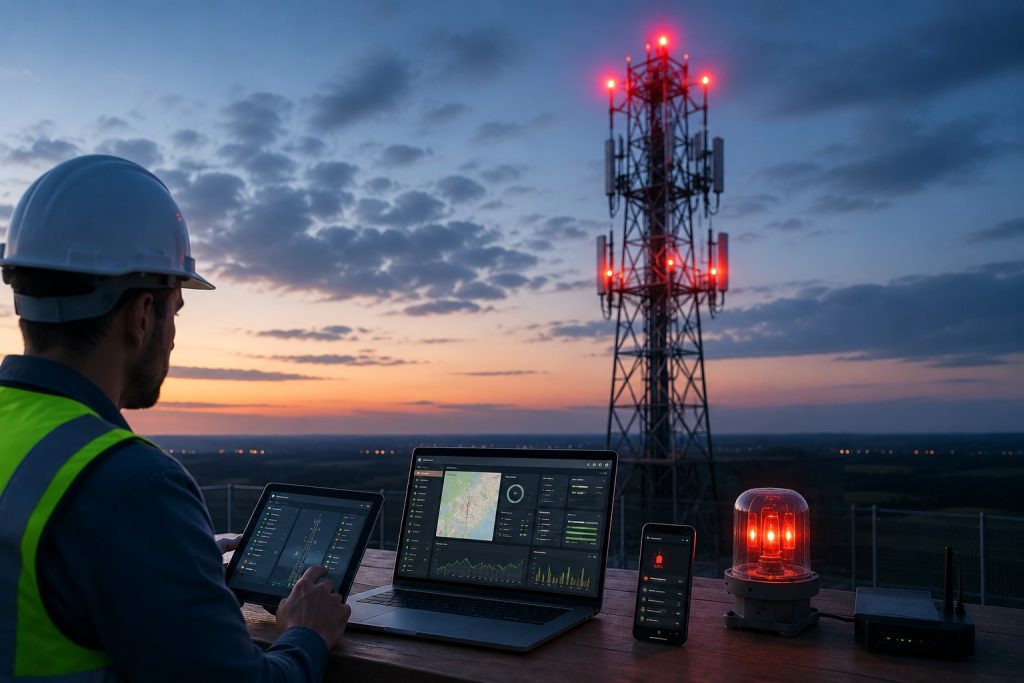

Telecom infrastructure depends on uninterrupted visibility across distributed tower environments. Obstruction lighting failures, communication interruptions, and delayed alarm responses can create operational risks that affect compliance, uptime, and maintenance efficiency.
Tower Light Monitoring Solutions help telecom operators transform isolated alarm systems into centralized operational intelligence. By combining Remote Monitoring & Control (RMC), actionable intelligence platforms, gateways, and integrated telecom monitoring, organizations gain stronger control over distributed infrastructure and compliance workflows.
PLC Group supports this approach through integrated telecom infrastructure solutions designed for mission-critical environments, operational excellence, and long-term network reliability.
1. Centralized Tower Light Monitoring Improves Alarm Visibility
Distributed telecom sites often generate fragmented alerts that are difficult to manage through manual processes alone. Centralized Tower Light Monitoring Solutions improve operational visibility by converting lighting alarms, controller conditions, communication failures, and power events into structured monitoring workflows.
This approach allows operations teams to identify the exact source of a failure before dispatching technicians. Instead of responding to generic alarms, teams gain actionable intelligence tied directly to lamp status, utility conditions, controller health, and communication interruptions.
Centralized monitoring also supports audit-ready operational records. Event timelines, acknowledgements, and alarm histories remain accessible through unified dashboards, improving governance across telecom portfolios.
PLC Group’s Remote Monitoring & Control ecosystem supports centralized monitoring environments that help telecom operators improve infrastructure visibility while reducing operational complexity.
2. Remote Monitoring Architecture Strengthens Telecom Reliability
A Remote Monitoring System Telecom Tower architecture combines gateways, controllers, sensors, and communication networks into a resilient operational framework. The objective is not only alarm delivery but also reliable event preservation during communication interruptions.
Modern telecom infrastructure environments often depend on LTE, Ethernet, satellite, SNMP, MQTT, and Modbus communication pathways. Intelligent gateways help normalize alarm inputs and maintain event continuity when temporary network disruptions occur.
PLC Group’s infrastructure ecosystem emphasizes connectivity, visibility, analytics, and optimization across distributed facilities. This supports telecom operators seeking stronger network availability, operational excellence, and proactive site management.
Important Areas To Evaluate
- Communication redundancy across remote sites
- Gateway support for SNMP and Modbus protocols
- Edge-level alarm classification capabilities
- Integration with telecom infrastructure systems
- Centralized operational dashboards
3. Integrated Monitoring Creates Actionable Intelligence
Telecom operators increasingly require more than standalone tower light alarms. Integrated infrastructure visibility allows teams to connect obstruction lighting with cooling systems, energy management, environmental monitoring, and facility performance analytics.
PLC Group’s AxIn platform focuses on actionable intelligence through centralized analytics, reporting, operational monitoring, and infrastructure optimization. These capabilities help organizations identify underperforming sites, improve outage response, and strengthen operational planning.
Integrated telecom monitoring environments also support:
- Real-time alarm escalation
- Remote troubleshooting
- Predictive maintenance workflows
- Site health analysis
- Infrastructure performance optimization
This operational model reduces reactive maintenance while improving decision-making across distributed telecom assets.
4. Tower Light Monitoring Supports Long-Term Operational Efficiency
Reactive tower management often increases OPEX exposure through unnecessary dispatches, delayed issue resolution, and limited infrastructure visibility. Tower Light Monitoring Solutions support long-term operational efficiency by improving alarm ownership, reducing manual oversight, and streamlining maintenance coordination.
Integrated monitoring platforms also support broader telecom infrastructure goals such as energy optimization, uptime management, and operational forecasting. PLC Group’s ecosystem combines Remote Monitoring & Control, analytics, HVAC integration, and telecom site intelligence into a scalable operational framework for critical infrastructure environments.
Organizations operating large telecom portfolios benefit from:
- Faster root cause analysis
- Reduced emergency dispatches
- Improved compliance visibility
- Better operational coordination
- Stronger infrastructure governance
Smarter Telecom Monitoring Starts With Integrated Visibility
Tower Light Monitoring Solutions now play a larger role in telecom infrastructure management than simple obstruction lighting alerts. Centralized monitoring, actionable intelligence, integrated analytics, and resilient communication architecture help operators improve reliability across distributed tower portfolios.
PLC Group combines Remote Monitoring & Control platforms, intelligent gateways, operational analytics, and telecom infrastructure expertise to support long-term operational visibility and compliance readiness.
Contact PLC Group to learn how integrated Tower Light Monitoring Solutions can improve telecom infrastructure reliability, operational efficiency, and centralized site visibility.